 Race Suits


 Jackets


 Hoodies


 Shirts


 Pants


 Kids Gear


 Gloves
 Leather


Table of contents
No headings found in this article.
Australia has lab-tested women's motorcycle leggings twice. Both times, most of them failed.
Not "could do better." Failed. In the most recent round, textile scientists at Deakin University bought leggings and jeggings from ten brands at retail and put them through the MotoCAP test programme. Seven of the ten scored half a star out of five. The best result any motorcycle legging has ever recorded, from any brand, anywhere, is two stars.
Every one of those brands sells its product as protective gear.
The short answer: most leggings on sale today are not safe in any way you can verify, and a few are genuinely good urban gear. What separates them isn't the price or the fibre on the label — it's three things you can check in sixty seconds: whether the protective layer covers the places you actually land, whether the seams will hold, and whether knee and hip armour comes in the box. This page gives you the published evidence, every legging you can buy in Australia with prices, and the checklist. We sell leggings too, and ours is in the table on the same terms as everyone else's.
On this page: 1. What the testing found · 2. Why they fail · 3. The two certificates sellers blur · 4. What the law requires · 5. The heat argument · 6. The Australian shelf, with prices · 7. The five checks · 8. Our own answer sheet · 9. So should you buy a pair? · Quick answers
1. What Australia's own testing found
MotoCAP is the only programme in the world that buys riding gear off the shelf and publishes what it finds. Protection is scored out of five stars: 50% abrasion resistance, 30% impact protection, 20% seam burst strength. Do badly enough on any one of those and the score is capped no matter how the rest went. Its own guidance is two stars minimum for city riding, three for the open road (MotoCAP).
Here is every women's legging and jegging result ever made public, across both rounds.
| Tested | Product | Protection score | Source |
|---|---|---|---|
| 2020 | Resurgence Sara Jane Ladies Leggings | 2★ — best legging result on record | RideApart, webBikeWorld |
| 2020 | Oxford Super Leggings | 0.5★ | RideApart, as above |
| 2020 | Bull-It Fury SP120 Lite Jeggings | 0.5★ | RideApart, as above |
| 2020 | Draggin Stealthz Leggings | 0.5★ | RideApart, as above |
| 2020 | RJays Voyager V Ladies | 0.5★ | RideApart, as above |
| 2020 | RJays Dune Ladies | 0.5★ | RideApart, as above |
| 2023 | MotoGirl Sherrie | 2★ | Bennetts BikeSocial |
| 2023 | Resurgence Sara Jane (re-test) | 2★ | Bennetts, as above |
| 2023 | 7 of 10 tested brands (not individually named in public coverage) | 0.5★ | Deakin University |
Read it twice, because three things in that table matter more than anything else on this page.
No legging has ever reached the open-road threshold. Two stars is the ceiling, and two stars means city riding only — that is MotoCAP's wording, not ours.
The 2020 round wasn't a bad batch. Three years later, with the results public and the criticism loud, seven of ten brands still came in at half a star.
And the same research round found women's textile pants from major international brands scoring below two stars while comparable men's pants from the same market held four. Tested protection in women's gear has lagged men's. Not as an impression — as a measurement.
All of it is free to read. Browse every rating at motocap.com.au before you spend a dollar, on us or anyone.
2. Why they fail — the same three things, every time
The useful part of Deakin's work isn't the scores. It's that the researchers said exactly what went wrong (Deakin, Oct 2023):
- The protective layer was in the wrong places. 8 of 10 failed abrasion because the lining didn't properly cover the knees, the outer legs or the seat. In a slide, the fabric wore through exactly where riders land. A legging can contain genuine Kevlar® and still fail here — small panels in the wrong places protect the marketing copy, not you.
- The seams let go. 8 of 10 had marginal or poor seam strength. Stretch garments live or die on stitching. When a seam opens mid-slide, the protective layer unzips and the rest of the garment stops mattering.
- There was no armour. 7 of 10 scored poorly on impact because most shipped with no knee or hip protectors at all. Fabric handles the sliding. It does nothing about the hitting. That's a separate job and most products simply didn't do it.
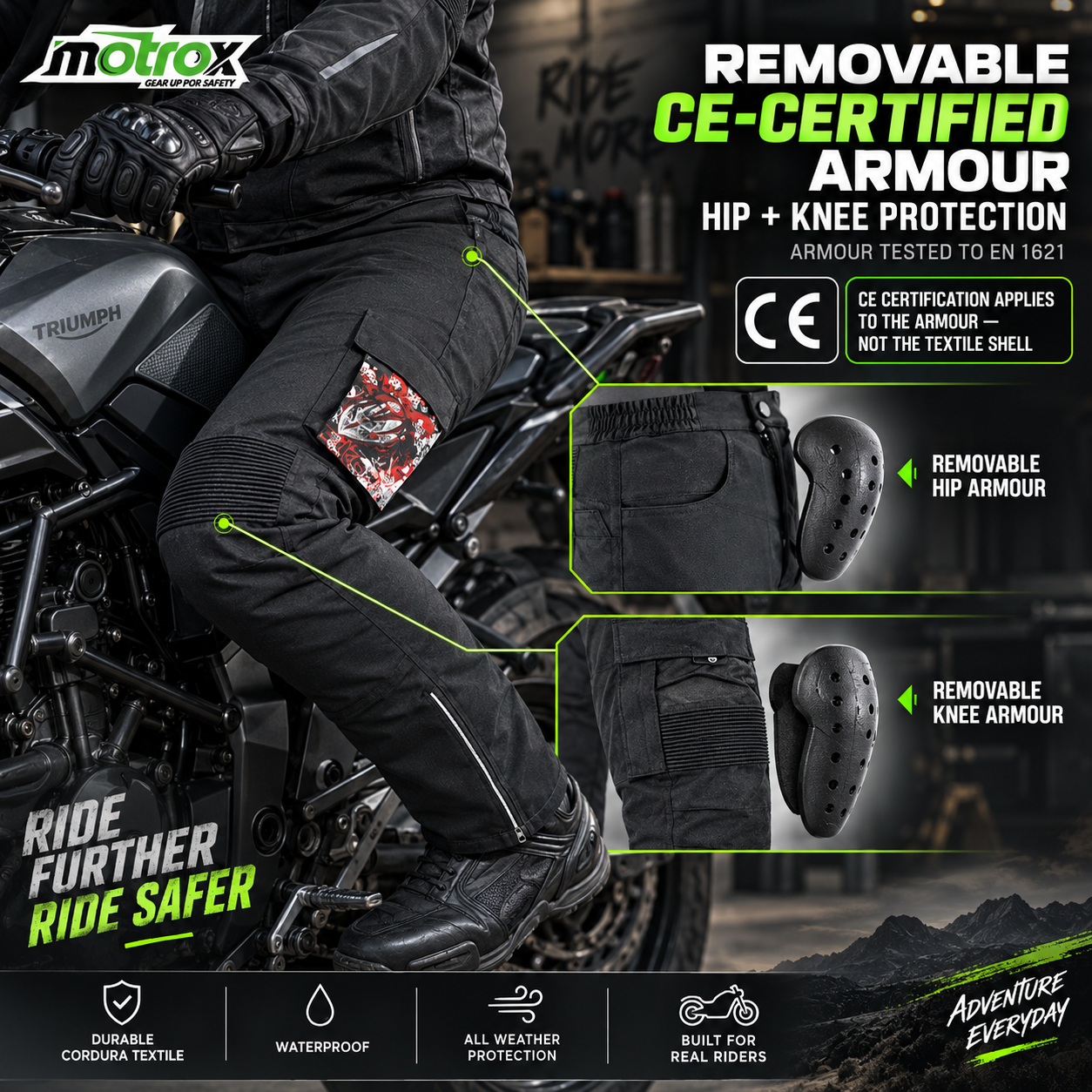
 CE Level 2 knee and hip protectors, certified to EN 1621. Seven of the ten products tested in 2023 shipped without them.
Those three are the entire distance between a half-star product and a two-star one. None of them is about the brand, and none of them needs a laboratory to spot — you can check all three from your couch, which is what the rest of this page is for.
And here is the part that should change how you shop. Three of the products that scored half a star — Oxford, Bull-It and Draggin — are aramid-lined. They contain real protective fibre. They failed anyway, because the fibre wasn't in the places that meet the road. So when you are comparing two leggings that both say Kevlar® on the page, the useful question isn't whether it's in there. It's how much of the leg it covers.
Ask the seller one question: where does the protective lining start and stop? A full-length lining through the knees, outer legs, seat and thighs is doing the job Deakin found missing. Two reinforcement patches at the knee are not, however good the fibre in them is — and a product page that won't tell you which one you're buying has told you something anyway.
3. The two certificates sellers blur together
Almost every misleading claim in this category comes from treating two different certificates as one. They are not the same, and the difference is the whole game.
EN 17092 certifies the garment. The entire legging goes to a lab — abrasion, seam strength, tear strength — and comes back rated A (urban), AA (urban and touring) or AAA (highest). This is the one that tells you whether the thing you're wearing will survive a slide.
EN 1621 certifies the armour, and only the armour. Level 1 is the baseline impact rating; Level 2 transmits less force to your body. The pad's certificate says nothing whatsoever about the fabric around it.
So "comes with CE armour" is not "CE certified garment," and most leggings on the market have the first and not the second. The word "CE" with no class letter after it is a half-claim.
Then ask the question almost nobody asks: can I see the test report? Not the letters on the page — the document, with a number on it and a lab's name. A seller who can produce one has earned the claim. A seller who can't is asking you to trust a fibre name. You will be surprised how often the answer is silence.
One Australian footnote worth knowing. EN 17092's abrasion test is based on European-style asphalt, and MotoCAP notes that Australian chip seal is roughly 4.5 times more abrasive than the smooth reference surface. A European certificate is a genuine signal of build quality. It is not a promise about a slide down a country road in New South Wales. That gap is the reason MotoCAP exists at all.
4. What the law actually requires (almost nothing)
| Where | What you must legally wear |
|---|---|
| Every state & territory | An approved helmet. That's it for full-licence riders. |
| NSW, from 1 Jul 2026 | Learners: hi-vis vest/jacket + approved gloves (EN 13594). P1/P2: the gloves. Pants were deliberately excluded (NSW Government) |
| VIC | Learners: hi-vis vest/jacket (Transport Victoria) |
No Australian law requires protective pants, for anyone. And no certification is legally required to sell riding gear here at all — MotoCAP states plainly that clothing sold in Australia isn't required to meet any minimum protection standard.
Three consequences follow. "Road legal" on a pair of pants means nothing. Anyone telling you leggings are required is selling you something. And the entire burden of choosing well has been handed to you, which is a strange thing to discover halfway through a purchase.
5. The heat argument is real, and it cuts both ways
University of Wollongong researchers put riders in full gear in a climate chamber at 25, 30 and 35°C. They found what every Australian rider already knows in their body: in hot weather riders are about three times less likely to wear protective gear — and heat stress degrades concentration on its own, before you've taken anything off.
This is the honest argument for a good legging, and it's a strong one. A two-star garment you actually put on in February protects you more than the four-star touring pant hanging in the cupboard, because the touring pant's rating is worth exactly nothing on days you don't wear it.
It is also where the argument gets abused. "Better than nothing" is true, and it is not the same as "good." The real question isn't leggings versus proper pants — it's what you will genuinely wear at 32°C for a twenty-minute commute, and whether you've picked the best thing in that category or just the first one that looked comfortable.
If heat is what's keeping your gear on the hook, we've written about the rest of that problem in our summer riding gear guide and in riding in 40°C.
6. Every legging on the Australian shelf, with prices
These are the women's riding leggings an Australian buyer is most likely to come across. Prices and availability were checked on 7 October 2026 and both move constantly, so verify before you buy. Disclosure: the Valkyrie is ours. It's in the table on the same terms as everything else, and it doesn't come out well on every row.
| Product | Typical AU price | Garment cert (as claimed by seller) | Armour included | Worth knowing |
|---|---|---|---|---|
| Oxford Super Leggings | $139–220 | CE A (some listings unstated) | L2 knee; hip sold separately | Cheapest branded entry; scored 0.5★ at MotoCAP in 2020 |
| Shark Legging Pro | $179–329 depending on discounting | None stated | None included | Armour pockets only — you buy the protection separately |
| Rebelhorn Chica | ~$246 (import) | AA, EN 17092-3 | L2 knee + hip | EU import via ChromeBurner |
| Macna Niche | $260 | Aramid liner, class unstated | L1 knee; hip pocket only | Hip armour not included |
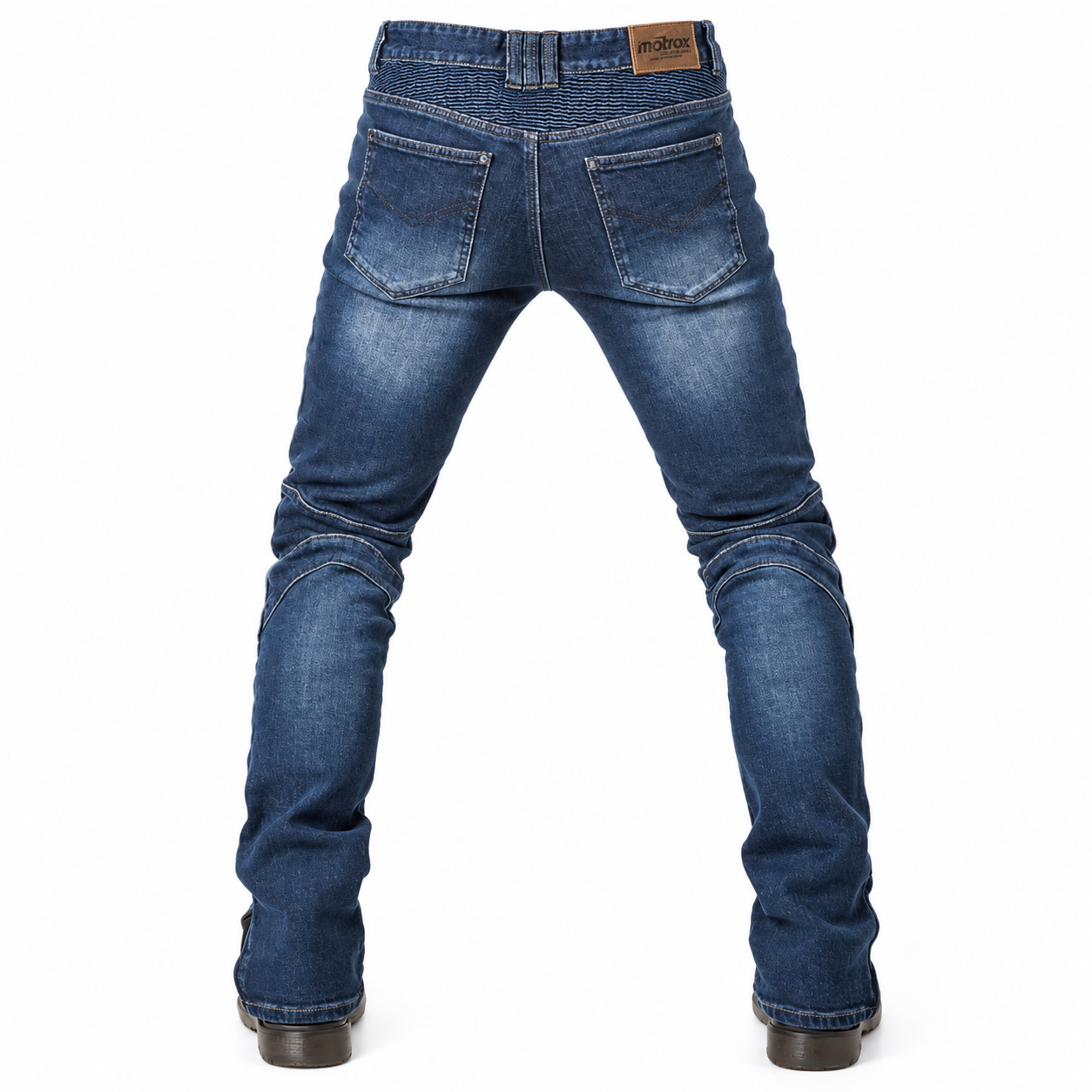
| Motrox Valkyrie™ (ours) | $289 | None — not garment-certified. Full-length DuPont™ Kevlar® aramid lining | L2 knee + hip + tailbone, every option | 11 waist sizes (28–48"), 3 leg lengths; free AU delivery; 15–19 day lead time |
| Knox Action Pro (unisex) | $289 | A, EN 17092-4 | L2 knee + hip + thigh + coccyx | Unisex cut; AU stockist availability varies |
| MotoGirl range | ~$270–325 (import) | AA, EN 17092-3 | L2 knee + hip | 2★ MotoCAP (Sherrie); no AU stockist found — import only |
| Resurgence Sara Jane | $349–369 | CE AA | Knee + hip | The only other 2★ legging; AU distributor stock |
| Draggin women's range | $309–379 | Varies by product | Varies | Australian heritage brand; Stealthz legging scored 0.5★ in 2020 |
| Pando Moto Skin UH | ~$405–490 (import) | AA / AAA claims | SAS-TEC L2 | Single-layer UHMWPE; the technical frontier, EU import |
Hold that table against the three failure modes from section 2 and the pattern is hard to miss. Under about $250 you are usually giving up the hip armour, the garment certificate, or both — and the things that failed in the lab are precisely the things being left out to hit a price. Above $250 the armour becomes reliable. The garment certificate does not, ours included.
Note also what the table cannot tell you: only two products in it have ever been independently tested, and both scored two stars. Everything else is the seller's own word.
7. The five checks — sixty seconds, in the shop
- A garment certificate, with the document. An EN 17092 class on the page and a test report you can open. No document, no claim — and that applies to every brand here.
- Knee and hip armour, included, EN 1621, Level 2 where you can get it. Missing hip armour was one of the most common failures in testing. "Armour pockets" means you are buying the protection separately, at a cost nobody mentions until checkout.
- Coverage you can trace on the page. Full-length lining, or patches at the knee? Where exactly does the protective layer start and stop — knees, thighs, outer legs, hips, seat? The places Deakin found bare are the places riders land, and this single question separated the half-star products from the two-star ones more than any other.
- Seams. Multi-needle, reinforced stitching. The dullest spec on this list and the second most common reason products failed.
- A size that actually fits you. A legging that's loose or long puts the armour somewhere other than your knee at the one moment it matters. If the size chart doesn't properly cover you, it's the wrong product — whoever makes it.
8. Our own answer sheet, including the check we fail
Fair's fair. Here is the Valkyrie™ against those five checks, starting with the one we don't pass.

1. Garment certificate — no. We don't have one. The Valkyrie is not certified as a garment to EN 17092. We could put a class letter on the page; plenty of sellers do, and almost nobody checks. But this page has just spent a thousand words telling you not to accept a letter without a report behind it, and we're not going to write ourselves an exception. There will be no class claim on our leggings until there is a document with a number on it that you can open. By our own first check, we fail.
2. Armour — yes, in the box. Every armour option includes knee and hip protectors certified to EN 1621 Level 2, plus a tailbone protector. Nothing sold separately, no empty pockets.
3. Coverage — full length. Genuine DuPont™ Kevlar® aramid lining running the length of the legging rather than patches at the knee. Coverage was the single most common reason products failed Deakin's testing, so it's where the most went.
4. Seams — three-needle overlock, double reinforced. Dull, and second on the failure list.
5. Sizing — eleven waist sizes, 28 to 48 inch, in three leg lengths. Petite, tall and plus riders are in the size run rather than an apology at the end of it.
Four out of five, and we'd rather name the missing one than hope you don't ask. It's also not waterproof, not a touring pant, and not a substitute for heavier gear on a long highway day.
9. So — should you buy a pair?
Here's the rule, and it doesn't always point at us.
Buy a riding legging if your riding is commuting, errands and short urban trips, and the honest alternative is ordinary jeans or nothing at all. A certified, armoured legging you wear every single day beats touring pants you don't own, and that is a genuinely good reason to buy one. Just buy a good one.
Don't buy a riding legging if you're doing highway distance, weekend rides at open-road speeds, or touring. No legging has ever scored above two stars, and two stars is MotoCAP's city-riding threshold. Buy proper pants instead. If that means not buying from us, then don't buy from us — we'd rather lose the sale than have you find out the hard way.
If you do buy one, spend the sixty seconds on the five checks before you pay. The gap between a half-star product and a two-star one is not mostly about money — it's coverage, seams and what's in the box, and plenty of expensive leggings fail on all three.
And whoever you buy from, carry one habit out of this page: ask for the test report. Not the class letter, the document. In a market with no mandatory standard and no legal requirement, that single question is the only quality control that exists — and the industry will only start publishing those reports when enough riders make a habit of asking.
If you want to talk sizing before you commit, send us your waist, hip and inside-leg measurements and we'll tell you honestly whether we have something that fits. The women's leggings collection is here if you want to look.
Quick answers
Are motorcycle leggings safe? Most sold today haven't proven it. Seven of ten brands scored half a star in Australia's 2023 government-backed testing, and the best legging ever tested scored two out of five — MotoCAP's city riding threshold. A certified, properly armoured legging is legitimate urban and commuter gear. None of them is open-road touring gear.
Are Kevlar leggings crash-proof? No garment is, and the fibre name on its own proves nothing. Coverage area, seam strength and included armour decided every single test result — not the brand of fibre inside.
Do I legally need motorcycle pants in Australia? No. A helmet is the only nationwide requirement. NSW's 2026 novice rules add gloves and learner hi-vis, and pants were deliberately left out.
What does CE AA actually mean? That the whole garment passed EN 17092-3 lab tests for abrasion, seams and tear at the urban-and-touring level. It is a completely different certificate from the CE marking on the armour inside, which is EN 1621.
What should leggings cost? The Australian shelf runs from about $140 to about $490. Below roughly $250, something on the five-point checklist is usually missing. Decide what you're willing to go without knowingly, rather than because a product page went quiet about it.
All test results and legal statements above are reported from the cited public sources; ratings belong to MotoCAP, and the brands named were tested by MotoCAP/Deakin, not by Motrox. Prices and availability checked 7 October 2026. Sources: MotoCAP women's leggings · MotoCAP pants database · Deakin University · RideApart (2020 round) · Bennetts BikeSocial (2023 round) · MotoCAP on Australian road abrasion · NSW Government · Transport Victoria · University of Wollongong
Popular with riders


- CE armour

- CE armour
- Kevlar®

- CE armour

- CE armour
- Made to measure