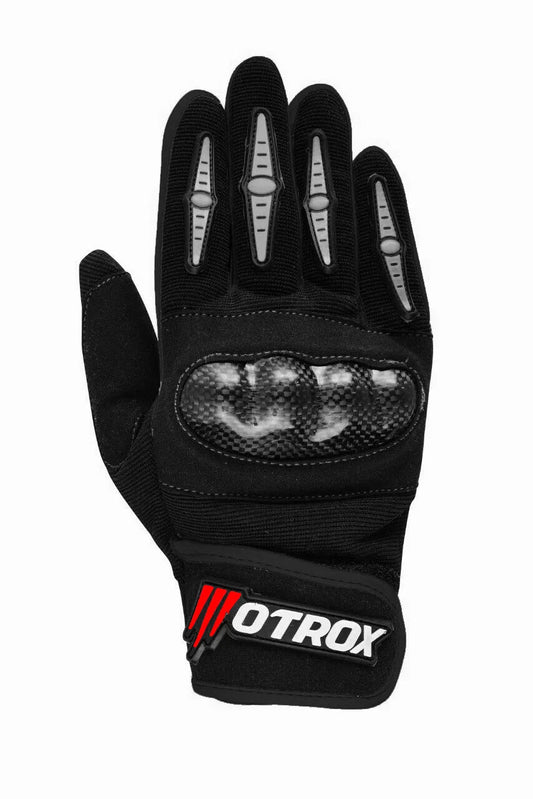
Most riders buy their first pair on price and their second pair on fit. Here's how to skip straight to the second decision.
Fit is the whole thing
Too big and it bunches in the palm and slides under your hand on the bar. Too small and your fingers go numb inside twenty minutes, with the knuckle armour sitting above your knuckles instead of on them. Neither protects properly, and neither is comfortable enough that you'll keep wearing it.
Measure two things, not one: the circumference of your hand just below the knuckles with your thumb excluded, and the length from the tip of your middle finger to your wrist crease. Whichever puts you in the larger size wins.
What knuckle armour actually does
A hard shell spreads an impact over a wider area instead of letting it land on bone. It only works if it sits on your knuckle — which makes it a sizing question as much as a product one. If yours digs in when you grip the bars, the glove is usually a size too small.
Why the palm matters more than the logo
When you come off, your palm hits first and slides. That's the contact area, that's where abrasion happens, and it's the first place a poorly built glove fails. Reinforcement there isn't a nice-to-have — it's the point.
Breathability is an Australian problem
Northern-hemisphere gear reviews are written for riders who worry about cold. Ours ride in thirty-eight degrees in February. A glove that cooks your hands is a glove you'll leave at home, and a glove you leave at home protects nothing.
Getting the closure right
A wrist strap isn't styling. Gloves that pull on without a closure can come off in a crash. Fasten it so the glove doesn't move when you tug it, without cutting into your wrist.