 Race Suits


 Jackets


 Hoodies


 Shirts


 Pants


 Kids Gear


 Gloves
 Vests


Table of contents
No headings found in this article.
For parents, clubs and teams — mini moto, MiniGP, motocross and road pillion. What a young rider needs, what the rules ask for, what "CE" really covers, and how to get a suit that fits the child you have today.
The quick guide
A child on any motorcycle needs the same protection as an adult: a helmet to a recognised standard, a leather suit (or armoured jacket and trousers) with protectors at the shoulders, elbows and knees, a back protector, gloves and over-the-ankle boots. Every item has to fit the child today, not the child they will be next year. For racing, the organiser's rulebook decides the details.
- Mini moto, MiniGP, pit bike on tarmac: leather race suit (one-piece is the safe default), back protector, leather boots and gloves, full-face helmet. Chest protector where the series asks.
- Club road racing: the same, to your federation's rules.
- Motocross and dirt: MX jersey and pants over chest, back and knee protection, MX boots, goggles, off-road helmet.
- Road pillion: armoured jacket and trousers or a suit, boots, gloves, road-legal helmet that fits.
- First laps on private land: the full kit anyway.
- Fit today. Buy to the child's measurements now. A size up moves the armour off the joints.
- Protectors certified. Look for EN 1621 labels on every insert, including the back protector.
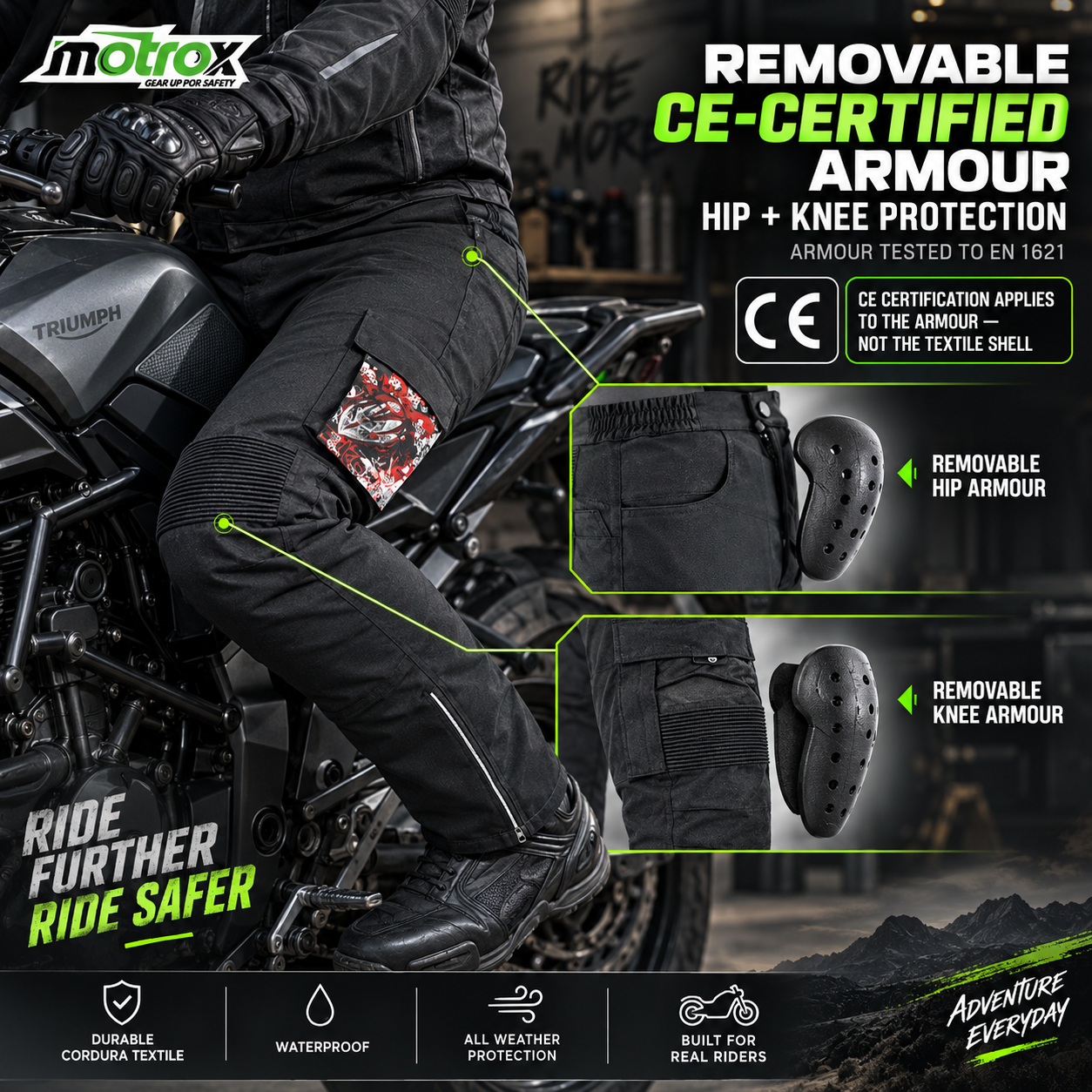
- A suit is not a certified garment unless its own label says so. "CE" on a kids' suit usually means only the armour inside it is certified.
- Gear by riding type
- Mini moto, MiniGP and pit bikes
- Should you buy a size up?
- What actually protects a child
- Helmets
- Heat
- Leather, textile, one-piece or two-piece
- Race rules in brief
- What "CE" really means
- Sizing systems
- How to measure a child
- Made-to-measure vs off-the-rack
- Clubs, academies and teams
- Checklist, red flags, kit bag, first season
- What it costs
- Second-hand, care and replacing
- Buying from overseas
- The Motrox kids range
- FAQ
- The bottom line
- Sources and method
Motrox makes kids' leather race suits for ages 4–16, built to your child's measurements at no extra cost.
Free delivery on leather · Duties and import taxes paid to Australia, the UK and New Zealand · 15–19 business days from design approval
Send the measurements before you pay and we'll tell you whether a standard size fits or made-to-measure is the better call. No charge either way. We reply within 48 hours. Prefer WhatsApp? Message us on WhatsApp. Christmas delivery: order by 30 November. Buying as a gift? Order now and we'll contact you for the measurements, or send the measurements first and order once we've checked them together. What is certified in our suits and what isn't: see our range, scored against this guide.
Gear by riding type
What a child needs depends on where they ride. Tarmac riding (mini moto, MiniGP, club racing) calls for road-race gear: leather suit, back protector, leather boots and gloves, full-face helmet. Motocross calls for MX clothing over separate body armour. Road pillion calls for the same armoured kit an adult would wear. Use the table as a starting point; the organiser's rulebook always wins.

| Riding type | Suit or clothing | Back and chest | Boots, gloves, helmet | Who sets the rules |
|---|---|---|---|---|
| Mini moto / pocket bike (kart tracks, club days) | One-piece leather race suit; some organisers (e.g. the ACU) accept a minimoto suit for juniors. Motocross clothing is usually not accepted. | Back protector almost always required; chest required by some series. | Leather boots overlapping the suit; leather gloves; full-face helmet (ECE 22.05/22.06, AS/NZS 1698, Snell, JIS or a national list). | Club or national federation. |
| MiniGP / minibike racing (Ohvale-type, 110–190 cc) | One-piece leather suit. Two-piece banned in FIM MotoMini and by RFME Spain; allowed if attached under MA and MNZ rules. | Back required. Chest required in FIM MotoMini, RFME, FFM, Malaysia, MNZ and FIM MiniGP Australia. | Racing boots and gloves; full-face helmet. | National federation, plus the FIM. |
| Club road racing (junior road-race classes) | Leather one-piece (ACU road race: at least 1.2 mm) or, where allowed, an attached two-piece (MA). | Back required; chest by series. | Boots with ankle and calf protection; leather gloves; single-shell full-face helmet. | National federation. |
| Motocross, dirt, trail | MX jersey and pants (clothing, not armour) over body armour and knee protection. | Chest and back required in AMA and ACU motocross. | MX boots, gloves, goggles; off-road helmet. | Federation or club MX rules. |
| Road pillion | Armoured jacket and trousers, or a suit, sized to the child. | Back protector recommended. | Over-ankle boots; gloves; road-legal helmet that fits. | Road law (see below). |
| First laps (paddock, private land) | Armoured jacket and long trousers at minimum. | Back protector recommended. | Boots (not trainers), gloves, full-face helmet. | You, with adult supervision. |

Fact The ACCC's miniature motorbikes guide says they are not toys, are illegal on public roads, should never be ridden by children without adult supervision, and riders should wear a helmet, goggles, long sleeves and pants, boots and gloves. That is the floor, not the ceiling.
Road pillion. Carrying a child on a road bike is governed by road law: minimum ages, footrest rules and which licence holders may carry a passenger change by country and, in Australia, by state. See Can a child ride pillion? Rules in Australia and around the world.
Motrox Kit for the first three rows: kids leather race suits. For pillion and first laps: kids motorcycle jackets. For motocross: the MX Junior jersey and pants, supplied with CE certified protectors at the shoulders, elbows, knees and back (helmet, boots and goggles are separate).
Mini moto, MiniGP and pit bikes
Mini motos and MiniGP bikes are small road-racing motorcycles ridden on sealed kart tracks at real speed, so the governing bodies treat them as road racing in miniature. That is why the required gear is road-race gear: leather suit, back protector, leather boots and gloves. Motocross clothing has no abrasion-resistant shell and many organisers exclude it. The names overlap and change by country:
- Mini moto (minimoto, pocket bike): a miniature road-race motorcycle with a rigid frame, 6.5-inch wheels, a centrifugal clutch and a kill switch (Motorcycling Australia's class definition), typically around 40 cc.
- MiniGP (minibike): larger race bikes with 10–12-inch wheels (Ohvale, GRC and similar) in 110, 160 and 190 cc classes, raced on kart tracks, including the FIM MotoMini World Series.
- Pit bike: a small dirt-styled bike, sometimes raced on tarmac in "pit bike" classes. MX kit or leathers, depending on the series.
- Supermoto: dirt-style bikes on road wheels and tyres, raced on circuits that mix tarmac and dirt. Check the series' clothing rule.
- Scrutineering: the check before a race meeting where officials inspect the bike and the rider's gear against the rulebook. Gear that fails does not race.
- One-piece: a race suit where jacket and trousers are a single garment. A two-piece is a jacket and trousers that zip together at the waist.

How young can they start?
It depends on the federation and class. Examples:
- Australia: Motorcycling Australia issues a first competition licence from six. Junior road-race classes run from "6 to under 10" (50 cc auto) up to MiniGP at "9 to under 15". For FIM MiniGP Australia 160 cc the manual says "9 to under 15" but the series page says 10–14: confirm with the organiser.
- United Kingdom: the ACU's minibike regulations start 40 cc classes at "6 Years Plus".
- Spain: the RFME Minimoto 5.5 class is for six- to nine-year-olds.
- FIM MotoMini World Series: 160 cc riders must have turned ten (maximum 14); 190 cc riders twelve (maximum 16).
Can a child ride a mini moto on the road?
No, anywhere we checked. In New South Wales pocket bikes are "prohibited vehicles", illegal on any road, footpath, car park or park; Queensland says the same; in the UK they are barred from roads, pavements and usually parkland. Riding happens on kart tracks, at club days and on private land with permission.
Growth vs fit: should you buy a size up?
No, not for anything with armour in it. Buy the size that fits now, take any growth allowance only as a little extra length at the cuff and ankle, and re-measure every three to four months. Here is the reasoning, so you can make the call yourself.

How fast do children grow?
After about age two, children grow roughly 6 cm a year until the pubertal growth spurt, usually between 8 and 13 in girls and 10 and 15 in boys (KidsHealth, a Nemours parent-information site). During the spurt, boys can add 10–12 cm in a year and girls 8–10 cm (StatPearls, 2023).
World Health Organization growth tables show why boys need extra attention in their teens. We took the median (middle) height at each birthday and worked out the typical gain across each two-year band, the bands many kids' suits are sold in:
| Age band | Boys: median height at start → end | Girls: median height at start → end | Who grows more in this band |
|---|---|---|---|
| 4–6 years | 103.3 → 116.0 cm (+12.7) | 102.7 → 115.1 cm (+12.4) | About even |
| 6–8 years | 116.0 → 127.3 cm (+11.3) | 115.1 → 126.6 cm (+11.5) | About even |
| 8–10 years | 127.3 → 137.8 cm (+10.5) | 126.6 → 138.6 cm (+12.0) | Girls, slightly |
| 10–12 years | 137.8 → 149.1 cm (+11.3) | 138.6 → 151.2 cm (+12.6) | Girls, slightly |
| 12–14 years | 149.1 → 163.2 cm (+14.1) | 151.2 → 159.8 cm (+8.6) | Boys, by a lot |
| 14–16 years | 163.2 → 172.9 cm (+9.7) | 159.8 → 162.5 cm (+2.7) | Boys, by a lot |
Our calculation from WHO medians: age 4 from the WHO Child Growth Standards; ages 6–16 from the WHO 2007 Growth Reference. Medians describe the middle child, not yours.
What it means for gear: up to about 12, boys and girls grow at similar rates. From 12 to 16 the median boy grows about 24 cm, the median girl about 11 cm. Re-measure boys aged 12–16 more often.
Why a size up is a protection problem, not just a comfort one
A protector only works over the joint it was placed for. In a sleeve that is too long, the elbow protector sits on the forearm; in a long leg, the knee protector sits on the shin; in a big chest, the whole suit, back protector included, can rotate in a slide. Australia's MotoCAP rating program scores exactly this. Add sleeves over the gloves and a gap above the boot that a scrutineer will fail, and "room to grow" has real costs.

Buy the size that fits now. If you want some allowance, take it where it does not move the armour: a little length at the cuff and ankle where the suit has stretch or adjustment. Never in the chest, the shoulder width or the shoulder-to-elbow length. Stretch panels and waist adjusters already give some room; use that, not a bigger size.
Re-measure every three to four months, and before every step up in class. Sooner if the sleeves look short. This is our recommendation, based on the growth figures above, not a rule in any standard.
Plan to replace it. For many families a kids' race suit lasts one or two seasons.
Motrox Don't buy big. We build to today's measurements, adding a little cuff and ankle length only if you ask. Made-to-measure never costs extra, so when they outgrow it, the next suit is built to fit too.
Others say the same: Victoria's Better Health Channel warns against a bicycle helmet bought too large "with the intention that they will 'grow into it'", and Zandonà sizes junior back protectors in 15 cm height bands.
Check the fit in the riding position. Tucked, arms forward, knees bent: sleeves reach the wrist bone, knee protectors sit centred on the kneecap, the suit meets the boot with no skin showing, and the child can turn their head and look up. Snug, not tight.
Motrox Send us the numbers. We'll confirm a standard size or build the suit to them, at the same price.
Safety: what actually protects a child
Protection comes from three things working together: a shell that resists abrasion (leather or technical textile), certified impact protectors that stay on the joints, and a helmet that fits. Fit keeps the protectors where they need to be. Each part has its own test, which is why "is it CE?" is never one question.
What the evidence says about gear (from adult riders)
No study has measured how much a suit or armour reduces injury in children. The evidence that gear works comes from adults. In a study of 212 crashed riders in New South Wales, those wearing motorcycle jackets, pants and gloves were significantly less likely to be admitted to hospital, and fitted body armour lowered the risk of upper-body, hand, leg and foot injuries further. The same study found no link between body armour and the risk of fractures: armour reduces impact and soft-tissue injuries, it does not guarantee against a broken bone (de Rome et al., 2011). A later study of protectors worn in real crashes found that the more force a protector let through, the higher the odds of injury beneath it (Albanese et al., 2017).
Three practical conclusions for children:
- Coverage matters more than a label: real protectors at shoulders, elbows, hips, knees and spine, not foam padding.
- Position matters as much as the protector. MotoCAP scores protectors on "size, position and how well the fastenings prevent the protector from moving". This is the case against oversized gear (see growth vs fit).
- "Certified" is a floor, not a ranking. MotoCAP reports that 45 garments certified to the European garment standard scored only half a star or one star for protection in its own tests.

What the research on children shows
In the studies we read, children's motorcycle injuries happen mostly off road, most often involve the limbs, and are most common in the early teens. They happen to children wearing helmets and motorcycle gear too. Each study counts a different group, so the numbers are not interchangeable:
- Victoria, hospital admissions (Bevan et al., MJA 2008; data 2000–2004): 167 Royal Children's Hospital admissions. 71% off road; 68% fractures, 24% head injuries, 14% internal (intra-abdominal) injuries; 27% under ten; 28% had no helmet where use was recorded. Across all Victorian emergency presentations in the same study, 89% were off road and 22% under ten.
- Queensland (Pym et al., J Paediatr Child Health 2013): 619 child motorcycle incidents over three years; median age 13; lower-limb injuries 44%, upper-limb 26%, head and neck 16%; ten deaths, nine involving head injury.
- Victoria, ambulance call-outs (Finch et al., Injury 2020; 2010–2017): 1,479 children under 16 attended for off-road motorcycle trauma. Paramedics recorded fractures in 25.5%. Four children died, all in recreational rather than organised riding.
- Rural and regional Australia (Mulligan et al., 2021): 30 children aged 4–16 showed "high rates of wearing helmets and motorcycle-specific garments" and still mostly limb injuries; the authors called for research into "the injury mitigation and fit properties of protective gear" for growing children.
- United States (CDC, MMWR 2006; data 2001–2004): an estimated 23,800 off-road motorcyclists under 19 treated in emergency departments each year, with the highest rate at ages 12–15.
- United Kingdom (Singh et al., J Child Orthop 2015): 130 children aged 4–17 injured in motocross; clavicle, forearm and leg fractures led; four serious head injuries needed neurosurgery.
- US competitive motocross (Bruney et al., 2024): serious injuries persisted despite rules requiring full-face helmets and chest and back protection.
Why the fracture figures differ: 68% of children admitted to hospital had fractures, but paramedics recorded fractures in about a quarter of those they attended. Both are right; admitted children are the more seriously hurt. And while injuries peak in the early teens, over a quarter of Victorian admissions were under ten.
What to take from it: the helmet most often decides the worst outcomes, limbs most often break, and nobody has yet measured how fit changes protection in children. Buy for the child you have.
Neck braces
The evidence is mixed. Trackside emergency records from the US Midwest (8,529 injured riders, 2009–2018) reported fewer critical neck injuries among brace wearers, but the data are not peer-reviewed. An Imperial College London modelling study (Khosroshahi et al., 2019) found the device "can in some cases increase the risk of neck injury". There are no studies in children; no tarmac rulebook we read mentions braces; the AMA lists them as "recommended" for motocross. If you use one, match it to the child's helmet and chest protector (a 2025 study linked brace fit to head movement).
For how Level 1 and Level 2 protectors are tested, see our CE Level 1 vs Level 2 armour guide; the short version is in what "CE" really means.
Helmets for children: standard, fit and weight
Choose a full-face helmet to the standard your country or organiser accepts, that fits the child's head today, is as light as you can find, and has never been dropped, crashed or owned by someone else.

- Standards. There is no separate children's motorcycle helmet standard. UN Regulation 22 (ECE 22.05/22.06) is tested on headforms down to 500 mm circumference, so small heads are covered. On Australian roads a helmet needs an AS/NZS 1698 or UNECE 22 label; MA's competition list adds Snell, JIS and FIM. Youth ECE 22.06 road full-faces are rare in Australia: in September 2026 we found only the LS2 FF812 Kid (about A$140). The alternative is an adult XS.
- Weight matters more for a child. A 2003 workshop on children's head and neck injury, run by the Children's Hospital of Philadelphia and the Snell Memorial Foundation, noted that a child's neck is "only 75% of adult size at age 4 and 85% of adult size by age 12", with weaker muscles, and that some motorsport helmets weigh "more than half the head weight of some of the children who wear them". Youth karting acted on this (Motorsport UK caps under-15s' helmets at 1,550 g); motorcycle standards set no cap, so choose the lightest certified helmet that fits.
- Fit. Measure head circumference just above the ears. With the strap done up, the helmet should not rotate, should stay put when the head tilts, and should resist being rolled off from the back (the NSW Government's method). The only child-specific fit research comes from bicycle helmets: a helmet 2 cm or more too wide roughly tripled the odds of head injury (Rivara et al., 1999).
- Never buy a used helmet, and replace one after any impact. See second-hand and care.
Riding in heat
Children aged about 10–16 are not at greater physiological risk from heat than adults, according to current sports-medicine guidance. The risk is behaviour: children often do not notice or act on warning signs, and leathers plus armour trap heat. Plan the day around that.
Sports Medicine Australia's Extreme Heat Risk and Response Guidelines (2025) say children "may respond differently to heat stress behaviourally, for example by not recognising warning signs or failing to modify activity or seek cooling", and tell organisers to "err on the side of caution". The American Academy of Pediatrics (2011) lists "inappropriately wearing clothing, uniforms, and protective equipment" among the causes of heat illness, suggests roughly 100–250 mL of fluid every 20 minutes for 9–12-year-olds during exertion, and recommends gradual acclimatisation to protective gear.
- A perforated suit and a removable mesh lining for hot tracks.
- A wicking base layer, not cotton.
- Suit unzipped and helmet off between sessions; shade.
- Drinks on a schedule, not "when thirsty".
- Shorter sessions on the first hot days of the season.
- One adult whose job is watching the child, not the lap times.
Leather, textile or "minimoto suit"; one-piece or two-piece
For tarmac racing, a leather one-piece is the safe default: it is what rulebooks describe, and every tarmac organiser we checked accepts it. Textile suits road riding and weather; a leather-and-stretch "minimoto suit" is a lighter entry option where the organiser allows it. Choose two-piece only if your series permits it.
The European garment standard, EN 17092, does not care what a suit is made of, only how it performs in abrasion, tear and seam-strength tests. In practice, for high-speed sliding, full-grain cowhide at around 1.2–1.3 mm is what almost every race suit is made from, adult or junior.
| Compared | Full leather race suit | Textile suit, or jacket and pants | Leather-and-stretch "minimoto suit" |
|---|---|---|---|
| Abrasion on tarmac | The reference material rulebooks describe. | Excellent to poor, by fabric and class. | Leather where the slide happens, stretch elsewhere. The ACU accepts one for juniors; not every federation does. |
| Impact protection | Comes from the protectors inside, not the leather. Check what is included. | Same: check the protectors. | Same; some entry suits come with "impact pads" or no armour. |
| Weight | Highest. A major-brand youth one-piece is around 3.1–3.5 kg. | Lower. | Lower than full leather. |
| Heat and weather | Hot: look for perforation and a removable mesh lining. Not for sustained rain. | Mesh options are cooler; waterproof options exist. | Cooler than full leather; not waterproof. |
| Typical price (Sept 2026) | Roughly A$300–A$1,300 / £190–£500 / €250–€700 for kids' one-pieces. | Generally lower, but kids' road textile is scarce. | Gimoto (Italy): Peewee Kid €249 (ages 8–15), Peewee Racing Kid €348 (ages 4–15), maker's prices before taxes. |
One-piece or two-piece?
The rulebook decides first. The FIM MotoMini World Series guide says "One piece leather suit (2-pieces suits are not allowed)". Spain's RFME bans two-piece suits in Minimoto 5.5. The ACU's road-race rules say "Suits zipped together at the waist are not permitted", though its minibike rules let juniors use a one-piece or a minimoto suit. Motorcycling Australia accepts "a one- or two-piece suit constructed of leather" if the jacket attaches securely to the trousers. MNZ recommends one-piece but allows a zip-together two-piece.
Growth decides second. Where allowed, a two-piece lets you replace only the half the child has outgrown, at the cost of a waist zip that must be done up every time and checked at scrutineering. Our 1-piece vs 2-piece leather suits comparison covers riding position and comfort; it applies to children too.
Race rules in brief
Almost every junior tarmac series requires a leather suit, a back protector, leather boots that overlap the suit, leather gloves and a full-face helmet. More and more also require a chest protector, and several ban two-piece suits. One line per organisation, from each current document. Rules change: read yours before you buy.
| Organisation (document) | Suit | Back and chest | Worth knowing |
|---|---|---|---|
| Motorcycling Australia (2026 Manual of Motorcycle Sport, Appendix A) | Road race: Clothing A, leather one- or two-piece, two-piece securely attached. Minimoto: Clothing A or E (minimoto suit, or MX pants and leather jacket plus armour; not Elite Open). | Back A: mandatory. Chest C: "strongly recommended". FIM MiniGP Australia requires both. | Road race: Footwear A (leather, overlapping the suit), Gloves B, Helmet C (single-shell full-face). The junior exception for synthetic boots (feet under size 1) is Footwear E, for motocross, not road race. |
| ACU, UK (Pocket & Mini Bike Standing Regulations 2025) | Juniors: one-piece leather or a proprietary minimoto suit. | Back protector required. Chest not specified. | Leather boots, no gap to the suit; no trainers. 40 cc from age 6. |
| FIM MotoMini World Series (Participants Guide 2026) | One-piece leather only. | Back and chest both mandatory. | 160 cc: turned 10, max 14. 190 cc: turned 12, max 16. |
| RFME, Spain (MiniVelocidad 2026, Minimoto 5.5) | One-piece; two-piece prohibited. | Back to EN 1621-2, Level 1 or 2. Chest to "prEN1621-3 or EN 14021". | Minimoto 5.5 is for ages 6–9. |
| FFM, France (Mini OGP 2026) | One-piece, or leather jacket and trousers joined by a zip. | Back (EN 1621-2) and chest (EN 1621-3) both mandatory. | Helmet must be less than five years old. Mini OGP 115 from 7 to 11. |
| MNZ, New Zealand (Road Racing Chapter 8, 2025–26) | One-piece recommended; zip-together two-piece allowed. | Back EN 1621-2 Level 1 and chest EN 1621-3 Level 2, both mandatory. | Boots at least 25 cm high; helmets under ten years old. |
| MotoAmerica Mini Cup, USA (2026 Regulations) | "A complete leather suit" with extra protection at the main contact points. | Back protector required; chest "recommended". | Undergarments must not be a synthetic that "might melt". Stock 50 for ages 6–8. |
Full country-by-country table: Junior motorcycle race gear rules by country (2026), with more organisations and the rule wording for each item.
Patterns: a back protector is required almost everywhere; a chest protector increasingly so, so buy a suit with room for one; and a one-piece is accepted by every organisation above, while several ban two-piece.
Adult track days are usually closed to juniors: Phillip Island, Sydney Motorsport Park and Champions Ride Days all exclude riders under 16. Start at a junior club day, an academy or a licensed junior meeting.
Motrox We can't speak for your scrutineer, and rules change. Our suits are leather with CE certified protectors and a CE certified back protector included. Send us your series' equipment rule before you order. We'll check it line by line and tell you if our suit doesn't meet it.
Racing soon? Order at least six weeks before round 1. Build and delivery take 15–19 business days from design approval, plus time for measuring questions and a fit check. Tell us your race date and we'll say honestly if we can make it.
What "CE" really means on a kids' suit
There are two different certifications on a motorcycle suit: one for the protectors inside it (EN 1621) and one for the garment itself (EN 17092). Most kids' suits carry only the first. A suit whose only CE labels are on the inserts is a garment containing certified protectors, not a certified garment.
Certified protectors (the armour)
Each insert is tested to EN 1621-1 (shoulders, elbows, hips, knees), EN 1621-2 (back) or EN 1621-3 (chest). The label on the insert shows the standard, the body zone (S, E, H, K…), the type (A or B, smaller or larger minimum coverage), the level (1 or 2), and optionally T+/T− if it also passed at +40 °C and −10 °C.
Level 1 limb protectors let through an average of less than 35 kN in the standard test; Level 2 less than 20 kN. For back protectors the limits are 18 kN (Level 1) and 9 kN (Level 2). Lower is better.
Certified garment (the suit itself)
The whole suit is tested to EN 17092 for abrasion, tearing, seam strength and protector coverage, and given a class: AAA (heavy-duty, typically race suits), AA, A, B (abrasion only, no protectors) or C (a protector carrier only). The sewn-in label shows the CE mark, a motorcyclist pictogram, "EN 17092-x:2020" and the class.

Chest protectors: two standards, one label to check
Many "junior chest protectors" are certified to EN 14021, the stone-shield (roost deflector) standard: a 1 kg striker at 10 J, transmitted force under 27 kN. It is a debris standard, not a crash-impact standard; EN 1621-3 is the crash-impact chest standard. Spain's RFME accepts either; France and New Zealand name EN 1621-3 only. Read the label and the rulebook.
Gloves and boots have levels too
A Level 2 glove under EN 13594:2015 needs at least 50 mm of cuff above the wrist (Level 1: 15 mm) and knuckle protection. A boot label under EN 13634:2017 shows four digits (height, abrasion, cut, rigidity), each 1 or 2. Certified youth road gloves and boots are scarce; many junior racers use leather motocross boots, which most tarmac organisers accept if they overlap the suit.
Does the garment standard apply to children?
Yes, but not automatically. EN 17092 has no child exemption that we could find; children's garments are certified under it when a maker submits them (we found a German youth textile jacket certified to Class AA). Most kids' leather suits are not submitted, so their "CE" refers to the inserts. A few major-brand youth race suits are sold with a class stated, such as "CE AAA". One quirk: EN 17092 excludes garments made "for motorsport competition events organized by a sanctioning body", so race suits are a grey area even for adults.
The ladder of claims
- Certified garment: an EN 17092 label with a class on the suit.
- Certified protectors only: EN 1621 labels on the inserts only.
- "Tested to", "compliant with": may be a self-declaration. Certification needs type-examination by an independent notified (UK: approved) body.
- "CE-style", "CE approved" with no standard number: marketing.
How to check, in five minutes
- Find the sewn-in label on the garment. Read the standard number and the class. No label, no garment certification.
- Pull out an insert and read its EN 1621 label: zone, type, level.
- Ask for the EU Declaration of Conformity (makers must supply it under the PPE Regulation, Article 15). A seller who cannot say which standard their "CE" refers to has answered your question.
- Know the road rule: in Australia (apart from New South Wales' 2026 glove and hi-vis rules for novice riders) and the US, road clothing need not be certified. See our Australian gear laws guide.
Our own position, stated plainly: the protectors in Motrox kids' suits are CE certified, Level 1 or Level 2, your choice; the leather shell is not a certified garment as sold, and we do not describe it as one. See the Motrox range.
Sizing: three systems, one child
Kids' suits are sold in at least three sizing systems (age bands, height sizes and letter sizes) that do not map onto each other or onto your child. The only reliable way to choose is to measure the child and compare the numbers with that product's own chart.
- Age bands (4–6, 6–8 … 14–16 years). Used by many makers, including us. A band is the maker's estimate of where most children of that age land. It is not a promise about yours, and it does not transfer between brands.
- Height sizes (120, 130, 140, 150 cm). Used by some major brands. Better than age, but chest and limb length still vary at the same height.
- Letter or numeric sizes (2XS–4XL; EU 44/46). Borrowed from adult systems and sometimes mapped to nothing a parent can measure.

Do not size from age alone, or from height alone. Two children of the same age can be a size apart in the chest; two of the same height can differ by several centimetres in sleeve and inside leg. Measure chest, waist, hips, height, sleeve and inside leg at minimum.
How to measure a child for a motorcycle suit
Two people, a soft tape, 15 minutes. Print our measuring sheet, fill it in, and send us a photo of it. We check the numbers against each other before anything is cut. The five in bold below (chest, waist, hips, sleeve and inside leg), plus height, are enough to pick a standard size from any brand's chart; the full 19 are what a pattern cutter needs for made-to-measure.

Set-up
- Clothing: the thin base layer they ride in. Not a jumper or jeans. If a separate protector goes under the suit, say so.
- Posture: standing naturally, arms relaxed, looking ahead.
- Tape: snug, not squashing, level for anything around the body. Centimetres, each measurement twice; if they differ by more than 1 cm, take a third.
- Who: one adult measures, one writes.
The 19 measurements (plus height and weight)
| # | Measurement | How to take it | Needed for (MTM = made-to-measure) |
|---|---|---|---|
| 1 | Neck | Around the base of the neck. | MTM |
| 2 | Chest | Around the fullest part of the chest, under the arms, tape level. | Both |
| 3 | Waist | Around the natural waistline, in line with the navel. | Both |
| 4 | Hips | Around the widest point of the hips and seat. | Both |
| 5 | Shoulder width | Across the back, from shoulder bone to shoulder bone. | MTM |
| 6 | Back length | From the base of the neck down the spine to the waist. | MTM; back protector |
| 7 | Side length | From the armpit down the side to the waist. | MTM |
| 8 | Bicep | Around the fullest part of the upper arm. | MTM |
| 9 | Forearm | Around the fullest part of the forearm. | MTM |
| 10 | Wrist | Around the wrist, over the wrist bone. | MTM; cuff |
| 11 | Elbow to wrist | From the point of the elbow to the wrist bone, arm bent. | MTM; elbow protector |
| 12 | Sleeve | From the shoulder bone (the tip of the shoulder) to the wrist bone, arm slightly bent. | Both; most often wrong |
| 13 | Thigh | Around the thigh, 10 cm below the crotch. | MTM |
| 14 | Knee | Around the kneecap, leg straight. | MTM |
| 15 | Calf | Around the fullest part of the calf. | MTM |
| 16 | Ankle | Around the ankle, over the ankle bone. | MTM; boot overlap |
| 17 | Waist to knee | From the natural waist down the outside of the leg to the centre of the kneecap. | MTM; knee protector |
| 18 | Knee to ankle | From the centre of the kneecap to the ankle bone. | MTM; knee protector |
| 19 | Inside leg | From the crotch down the inside of the leg to the ankle bone. | Both; boot overlap |
Plus height (no shoes, back against a wall, floor to top of head), weight and age, so the cutter knows how much growth to expect. If a maker's form describes a measurement differently, follow the form.
The mistakes we see most
- Measuring over a hoodie or jeans, then wondering why the suit is loose.
- Sleeve measured from the neck instead of the shoulder bone (charts differ, so check which one the chart asks for).
- Rounding up "for growth" on every line: that adds up to two sizes.
- Sending last season's numbers.
Motrox Send us the measurements before you pay. We'll tell you if a standard size fits or if made-to-measure is the better call. No charge either way.
Our size guide has the general measuring method with diagrams.
Made-to-measure vs off-the-rack
Choose a standard size when the child's core measurements sit comfortably inside one band on the maker's chart. Choose made-to-measure when they straddle two bands, when sleeve or leg length is off the chart for the chest size, or when it costs the same. Made-to-measure fixes proportions; it does not stop growth or change what the suit is certified for.
What made-to-measure fixes
- Proportions: long torso and short legs, or long arms on a slight chest.
- Armour position: elbow and knee protectors placed for that child's limbs, which is the whole point of the fit argument.
- Between sizes: the child who is a 6–8 in the chest and a 10–12 in the leg.
- Room for a chest or back protector worn under the suit, if you tell the cutter.
- Colours, name and race numbers, on request.
What it does not fix
- Growth: a perfectly cut suit stops fitting when the child grows. Re-measure on the same schedule.
- Certification: same protectors, same shell. Fit changes; certification does not.
- Bad measurements: the suit is cut to the numbers you send, which is why custom orders are non-refundable for change of mind almost everywhere, including with us.
- Speed: made to order means weeks, not days.
Why a custom suit is not sold as a certified garment
A garment certificate covers one locked, final design: the pattern, panels, leather, seams, protector positions and size range the certifying body examined. Change any of those and the certificate no longer covers the suit, so a one-off custom suit is not a certified garment. The EU PPE Regulation allows made-to-measure only where the certificate records how far fit may vary from an approved base model. For a team that needs certification, one locked design in a size run is the realistic route.
How it works at Motrox, in four steps:

- You order, then send the measurements. Choose Custom made as the size and add the suit to your cart. After your order we contact you for the measurements (the 19 above, plus height, weight and age) and your colours, perforation and any name or numbers. Or enter the measurements on our measurements page straight away.
- We check them. If a number looks off against the others, we ask before anything is cut.
- You approve the design before production starts.
- It is built and delivered free: 15–19 business days from design approval.
Clubs, academies and teams
A club or team fleet needs a spread of sizes by height rather than made-to-measure, washable liners, spare protectors and a repair route, and an order confirmed six to eight weeks before the first round.

How programmes do it. FIM MotoMini Australia tells newcomers that helmet, leathers, leather gloves and boots are required and that "hire is available as well if you don't have it all", through its clubs. New Zealand's MiniGP Academy runs a loan fleet of helmets, boots, one-piece leathers and junior gloves for riders from five. In the UK, Cool FAB's Scott Redding Young Riders Academy hires "bikes and all protective gear" at a subsidised £40 a session. The Oceania Junior Cup supplies series leathers, helmet, boots and gloves, with a trackside repair pop-up.
What a fleet buyer should specify
- Sizes by height, not age: roughly 105–165 cm in 10–15 cm steps mirrors how youth protector makers size (Zandonà: 105–120, 121–135, 136–150, 151–165 cm). Two-piece suits, where allowed, let a fleet mix jacket and trouser sizes.
- Hygiene: washable liners; riders wear their own base layer.
- Rules built in: a back protector in every suit; a chest-protector pocket if your federation requires or recommends one; one-piece if your series bans two-piece.
- Spares: knee sliders, protectors and a repair route.
- Paperwork: a protector certification statement for the scrutineer.
Motrox We build bulk and team orders in club colours and numbers (see custom work). Send the size list and your federation's equipment rule and we'll quote the fleet.
What good kids' gear looks like: checklist and red flags
Good kids' gear states its leather and thickness, names the protector standard and positions, has strong stitching and stretch where a child bends, comes with a centimetre size chart, and is sold by a business you can contact. A cheap suit that is properly made and fitted beats an expensive one that does not fit.
Buying checklist
- Shell material and thickness stated: full-grain or top-grain cowhide, typically 1.2–1.3 mm on a race suit (jackets often 1.1–1.2 mm).
- Protectors included, positions listed, standard named: shoulders, elbows and knees at minimum; hips on a race suit; a back protector included or a pocket for one; a chest pocket if your organiser requires chest protection.
- Stitching: double or triple on main seams, bonded nylon thread.
- Closures: quality zips; cuffs and ankles that close over gloves and boots; a full waist zip on a two-piece.
- Stretch where a child bends: accordion or stretch panels at the back, crotch, behind the knees and inside the elbows.
- Sliders: replaceable knee sliders on a track suit.
- A size chart in centimetres, and a way to ask.
- A named business, a contact route and a returns policy you can read before paying.

Eight red flags
- "CE approved" with no standard number or class, and no answer when you ask.
- "Armour" that turns out to be foam padding, or armour "not included" in a product sold as protective.
- No size chart, or a chart in ages only.
- Advice to buy a size up "so it lasts".
- Costume-style "race suits" with no protectors, sold beside real ones.
- A one-piece with no stretch panels: a child cannot tuck in it.
- No returns policy, no business address, no way to reach a person.
- A price that is a fraction of the cost of the leather it claims to be made from.

Common mistakes
- Buying by age or height without measuring.
- Motocross kit for a kart-track class that requires leathers, or a two-piece for a one-piece-only series.
- Forgetting the back or chest protector until scrutineering.
- Boots that stop below the suit leg, or trainers.
- Checking fit at a mirror instead of tucked on the bike.
Race-day kit bag
- Helmet (and its bag)
- Race suit
- Gloves
- Boots
- Back protector, if it is separate from the suit
- Chest protector, if your series requires one
- Base layer, plus a spare
- Spare visor or tear-offs
- Licence and any entry paperwork
- A copy of the equipment rule
- Water, snacks and shade
- Soft tape measure for a quick fit check
A first-season timeline
- Try it first. A come-and-try or club ride day, in hire gear where it is offered.
- Join a club and get the licence your series needs, and download its current equipment rule.
- Measure and order at least six weeks before round 1. Made-to-order suits take weeks, and questions take time.
- Fit check on arrival, in the riding position, against the rulebook: boot overlap, sleeve length, back protector in place.
- Re-measure every three to four months, and before any step up in class.
What kids' motorcycle gear costs
Expect roughly A$450–A$700 / £300–£450 / €400–€600 for a cowhide kids' race suit with a full protector set. Entry suits sit below that; premium brands reach about A$1,300 / €700. A typical first road or minimoto kit in Australia, excluding the bike, comes to about A$870–A$1,120. Prices below are from retailer and maker websites on 22–23 September 2026, before shipping and import charges: a landscape, not a quote.
| Item | Price seen | Notes |
|---|---|---|
| Entry full-leather kids one-piece (UK marketplace brand) | £189.99 | "Impact pads"; no certification claim |
| Leather "mini moto junior" suit (UK) | £229.99 | Armour not included |
| Leather-and-stretch minimoto suits, Italy (Gimoto) | €249 (Peewee Kid) · €348 (Peewee Racing Kid) | Before taxes. Full-leather Minimoto Kid €390; made-to-measure from €618 |
| Kids suits, Spain (RPM Spirit) | €370–€395; custom €475–€600 | Measuring video |
| Australian mini moto junior suit (Ricondi) | from A$295 | Australian online listing |
| Motrox kids leather race suits (our own range) | A$499.99–A$699.99 with Level 1 armour; Level 2 +A$46 | Every size and made-to-measure at the same price |
| Major-brand youth one-piece (RST Tractech Evo 4 Youth) | £314.99–£324; US$539.99 | Retailer states CE AAA; only two sizes |
| Major-brand youth one-piece (Dainese Gen-Z Junior) | €449.97; US$381 | Sizes 122–164 |
| Bespoke kids suit, UK (MRA Kids Pro-Tech) | £499 | 26 measurements taken in person; 3–5 weeks |
| Major-brand youth one-piece (Alpinestars Youth GP Plus V2) | €699.95; about A$698 | Sizes 120–150 |
| Premium junior suit, Australia (4SR Junior AR) | A$1,299 | Retailer states EN 17092-2 AAA; back and chest protectors extra |
Three price tiers:
- Under A$450 / £300 / €400: entry suits. Some are sound; some lack real armour. Check what is included.
- A$450–A$700 / £300–£450 / €400–€600: race-thickness cowhide, a full protector set and a back protector are normal.
- Over A$700 / £450 / €600: brand, refinements and sometimes a stated garment class.
In Europe, made-to-measure costs roughly €80–€230 more than a standard size.
Motrox Why not a big brand? Some big-brand youth suits state a garment certification class; ours don't as sold, and that's a real difference. Ours give you ages 4–16 or made to measure, Level 2 on every protector for A$46, your colours, and free delivery with duties paid in Australia, the UK and New Zealand. The big-brand youth suits we found come in narrower size ranges (Alpinestars Youth GP Plus V2: 120–150 cm).
A typical first kit in Australia, excluding the bike
The rest of the kit can cost as much as the suit. Sensible entry prices from Australian retailers, 23 September 2026:
| Item | Example | Price | Note |
|---|---|---|---|
| Youth full-face road helmet | LS2 FF812 Kid (ECE 22.06) | A$139.99 | The only youth ECE 22.06 road full-face we found in a mainstream Australian shop |
| Youth boots | Rjays Youth Eagle | A$85.99 | No EN 13634 marking stated; youth MX boots (A$213.99–A$271.99) are the usual substitute |
| Youth gloves | Youth motocross gloves | A$35–A$72 | No youth leather road glove found in Australia; check your organiser accepts MX gloves |
| Youth back protector | Alpinestars Youth Nucleon KR-Y (EN 1621-2 Level 2) | A$107.96–A$119.95 | One size. Not needed if the suit includes a certified back protector |
| Kids leather race suit | Motrox kids one-piece (our own range) | A$499.99–A$699.99 | Level 1 armour; Level 2 +A$46 |
| Typical first road or minimoto kit, excluding bike | Helmet + boots + gloves + back protector + suit | about A$870–A$1,120 | With Level 1 armour and a separate back protector. Add A$46 for Level 2, and about A$170 if your series requires a chest protector |
| Typical first motocross kit, excluding bike | O'Neal Youth 1SRS helmet A$139.95 · Fly Maverik Youth boots A$179.99 · goggles A$53.99 · gloves A$34.99 · Leatt 2.5 Junior chest protector A$170.99 · MX Junior jersey and pants with protectors A$149.99 | about A$730 | The Leatt protector's chest is certified to EN 14021 (roost), not EN 1621-3; check your class rules |
Youth back and chest protectors: what exists
Youth Level 2 back protectors exist from Alpinestars (Youth Nucleon KR-Y), Zandonà (Netcube Back Pro Kid, from 121 cm) and as a Leatt upgrade insert. Youth EN 1621-3 chest protection is rarer: we found it only inside Alpinestars' Bionic youth jackets. Most "junior chest protectors" are EN 14021 roost deflectors, so check the label against your rulebook.
Second-hand, care and when to replace
A second-hand kids' suit can be a sound buy if it passes inspection, fits by measurement and gets new or checked protectors. A second-hand helmet never is. Replace protectors after an impact, and the suit when it stops fitting.
MotoCAP's view: "Second hand clothing may be perfectly fine to wear, but check carefully for crash damage or signs of degradation. Always replace the impact protectors with the best quality you can find." On helmets, Transport for NSW says: "You should not purchase a second-hand helmet, as it may have been involved in a crash or have experienced UV degradation."
Inspecting a used suit
- Ask whether it has been crashed. A crashed suit can be fine; protectors that took the hit are not.
- Leather and seams, in daylight: scuffs are normal; thinning, wear-through, cracks and broken stitching are not.
- Pull out every protector. All there? EN 1621 label? Cracked, crumbling or permanently squashed?
- Zips and Velcro: test every one.
- Fit the child, not the label. Everything in growth vs fit applies twice over, because you cannot get it altered by the maker.
Care
The maker's instructions come first. In general: armour out; protectors wiped, never machine-washed or folded; leather cleaned with a damp cloth and leather cleaner, air-dried in the shade, conditioned every few months; lining washed separately; suit hung somewhere cool and dry. Steps for our own gear are on the Motrox wash and care page.
When to replace
- After a crash where a protector took an impact: replace the protector, and inspect the shell for wear-through and seam damage.
- When protectors age: makers disagree, so read yours. Knox says replace "every 5 years regardless of condition"; SAS-TEC claims a ten-year life for its foam. MotoCAP warns that protectors "can suffer from compression damage that is not visible to the naked eye".
- Helmets: after any significant impact, even if it looks fine; MotoCAP suggests "around five years; or three years if used regularly".
Buying from overseas
The seller's price is not always the landed price. Australia and New Zealand collect GST at checkout on lower-value orders, and the UK does the same with VAT up to £135. The US now charges duty on every commercial import, and the EU adds a flat €3 per item on low-value orders from July 2026. Motrox pays duties and import taxes on deliveries to Australia, the UK and New Zealand, so there is nothing to pay at the door; elsewhere, your customs office may charge on delivery.
| Destination | Lower-value orders | Above the threshold |
|---|---|---|
| Australia | Up to A$1,000: 10% GST charged by the seller at checkout. | Duty (5% on leather apparel unless a free-trade agreement applies), GST and an import processing charge. |
| United Kingdom | Up to £135: 20% VAT charged by the seller at checkout. | Import VAT and duty collected before delivery, plus a carrier fee. |
| New Zealand | Up to NZ$1,000: 15% GST charged by the seller. | Duty, GST and levies collected by Customs. |
| United States | No duty-free allowance since 29 August 2025: duty on every commercial order, plus carrier brokerage. | |
| European Union | Up to €150: VAT at checkout plus a €3 per item customs duty from 1 July 2026. | VAT and duty. |
Checked against official sources on 23 September 2026. Rules in this area change fast; re-check before a large order. Returns across borders: a change-of-mind return is at the buyer's cost, and a made-to-measure suit cannot be returned for change of mind at all.
The Motrox kids range, scored the same way
This is the one section about our own products, scored against this guide's checklist. Every protector in our kids' suits is CE certified, Level 1 or Level 2 (your choice), back protector included. The leather suit itself is not a certified garment as sold. Every size, and made-to-measure, costs the same. Prices in Australian dollars, checked 29 September 2026.
Protectors certified
Removable CE certified protectors at shoulders, elbows and knees (plus hips on some two-pieces) and a CE certified back protector. Level 1 or Level 2, your choice; the level applies to every protector.
Garment certified
The leather shell is not certified under EN 17092 as sold. Garment certification (Class AA or AAA) is possible for a locked final design, on request; we give you the certifying body and certificate details in writing before you commit.
Construction
Full-grain cowhide, most styles 1.2–1.3 mm; stretch panels; knee and shoulder sliders; removable washable mesh lining; YKK zips; perforated options.
Fit
Age bands 4–6 to 14–16, or made-to-measure at the same price. Only Level 2 adds A$46: Estoril Junior A$599.99 or A$645.99; Avro Junior A$499.99 or A$545.99.
Lead time
15–19 business days from design approval. Order at least six weeks before round 1. For Christmas, order by 30 November.
Delivery and duties
Free on leather. Duties and import taxes paid by us to Australia, the UK and New Zealand.
Returns and cancellation
Stock sizes: 30 days to change your mind (unworn, tags attached; you pay return postage). Made-to-measure: cut for one child, so it can't be returned for change of mind. Cancel within 24 hours of ordering for a full refund; after that a 25% deduction applies until cutting starts, and once cutting starts it can't be cancelled. If we don't build it to your specifications, you get a replacement or a refund. Full terms: returns policy.
Reviews
Our kids' range has no reviews yet, and we won't borrow stars from other products.
Certified: every protector (shoulders, elbows, knees and back) to CE Level 1 or Level 2, your choice. Not certified as sold: the leather suit itself. We haven't lab-tested or crash-tested our suits and don't claim to. No FIM or MA homologation is claimed.
Which suit? One-piece for FIM- or RFME-style rules; two-piece (Avro Junior, Duo GP) only where your organiser accepts it; perforated for Australian summers. Level 1 or 2? Our opinion: Level 2 for tarmac racing; Level 1 is fine for first laps.
Also in the range: kids leather jackets, most with CE certified shoulder and elbow armour (three styles also come in a "No armour" version, which is not protective gear; the girls' Luna uses letter sizes), and the MX Junior jersey and pants (A$149.99) with the same protector set as our suits, for dirt, not the kart track.
What we still owe you: a kids' size chart measured from production samples (until then, send us the measurements and we'll confirm the size), and an armour brand and certificate number we can publish.
Made-to-measure is the "custom-made" option in the size list, at no extra cost. We reply within 48 hours. Questions: contact us or WhatsApp.
Young riders in Motrox leathers


Junior riders racing in suits supplied by Motrox. Photos used with the team's permission. Tap a photo to see it full size.
Frequently asked questions
How old does a child have to be to race a mini moto?
Usually six. Motorcycling Australia issues a first competition licence from six, the UK's ACU runs 40 cc classes from six, and Spain's Minimoto 5.5 class is for ages six to nine. FIM MotoMini World Series classes start at ten. Riding on private land is a parent's call, with supervision.
Does my child need leathers for minimoto in Australia?
For racing, in practice yes. Motorcycling Australia's 2026 manual sets minimoto clothing at Level A (a leather one- or two-piece suit, securely attached) or, outside Elite Open, Level E (a minimoto race suit, or MX pants with a leather jacket, plus armour). A back protector, leather boots, gloves and a full-face helmet are also required.
Should a child wear a one-piece or two-piece suit?
A one-piece is the safe default: every tarmac organisation we checked accepts it. Two-piece suits are banned in the FIM MotoMini World Series and Spain's Minimoto 5.5 class, and allowed only if zipped together in Australia and New Zealand. Where allowed, you can replace just the outgrown half.
What size motorcycle suit does my child need?
The size whose chart matches their measured chest, waist, hips, height, sleeve and inside leg, not their age. Brands size by age, height or letters, and the systems do not agree. Measure in a thin base layer, compare with that product's chart, and if the child falls between sizes, ask the seller or choose made-to-measure.
Should I buy a bigger size so it lasts?
No, not for anything with armour in it. A suit that is too big moves the elbow and knee protectors off the joints, lets the suit twist in a slide, and can fail scrutineering at the boot. Buy the size that fits now, allow a little cuff and ankle length only, and re-measure every three to four months.
Is Level 2 armour worth it for a child?
For tarmac racing, we think so. In the standard test a Level 2 limb protector lets through less than 20 kN on average, against less than 35 kN for Level 1; for back protectors the limits are 9 kN and 18 kN. For first laps at low speed, Level 1 is still certified protection.
Does a kids' race suit have to be CE certified?
Not in Australia or the US: road clothing there has no certification requirement, and race rulebooks specify materials and protectors rather than a garment class. In the EU and UK, clothing sold as protective must be certified PPE. Most kids' suits carry certified protectors in a shell that is not itself certified, so read the sewn-in label.
How long does a kids' leather suit last?
Structurally, many years with care. In practice, until the child outgrows it, which for many families is one or two seasons, and sooner for boys in their early teens. Protectors have their own life: replace them after an impact, and some makers say after five years regardless of condition.
Can a club or academy hire gear instead of buying it?
Many do. FIM MotoMini Australia says hire is available through its clubs, New Zealand's MiniGP Academy lends leathers, helmets, boots and gloves, and the UK's Scott Redding Young Riders Academy hires bikes and gear per session. Clubs building a fleet should size by height and order six to eight weeks ahead.
How do I measure my child for a motorcycle suit?
Two adults, a soft tape, about 15 minutes. The child stands naturally in a thin base layer. Measure in centimetres, each measurement twice. Chest, waist, hips, height, sleeve (shoulder bone to wrist bone) and inside leg pick a standard size; made-to-measure needs all 19 points, including elbow-to-wrist and knee-to-ankle.
Is second-hand kids' motorcycle gear OK?
A second-hand suit can be, if it fits by measurement and passes inspection: no worn-through or cracked leather, sound seams and zips, every protector present, labelled and undamaged. Replace the protectors if it has been crashed. Never buy a second-hand helmet: it may have been crashed, and its liner has moulded to another head.
How much does a kids' motorcycle suit cost?
In September 2026, cowhide kids' race suits with a full protector set mostly cost A$450–A$700, £300–£450 or €400–€600. Entry suits cost less and often lack certification or real armour; premium suits reach about A$1,300. A typical first road or minimoto kit in Australia, excluding the bike, is about A$870–A$1,120.
What helmet does a child need?
A full-face helmet to an adult standard (there is no children's one) that fits the child's head today and is as light as possible. On Australian roads it needs an AS/NZS 1698 or UNECE 22 label; Motorcycling Australia also accepts Snell, JIS and FIM for competition. Never buy a helmet second-hand.
How do I keep a child safe in leathers on a hot day?
Children aged about 10–16 handle heat physically as well as adults, says Sports Medicine Australia, but may miss warning signs. So plan for them: perforated suit, wicking base layer, suit unzipped and helmet off between sessions, shade, drinks on a schedule, shorter sessions early in summer, and an adult watching the child.
The bottom line
Start with where your child will ride and what the organiser requires. Then buy the protection that riding calls for: helmet, leather suit or armoured jacket and trousers with real protectors, back protector, chest protector where required, gloves and boots. Read the labels, so you know that "CE" on most kids' suits means the protectors, not the suit. Measure the child with a second adult, buy to today's measurements rather than a size up, and check the fit on the bike in the riding position. Put a re-measure date in the calendar every three to four months, and order at least six weeks before the first race. Where no standard size matches your child's proportions, made-to-measure is the right tool: choose a seller who checks the numbers with you before anything is cut.
Motrox Send us your child's numbers. We'll confirm a standard size or build the suit to them, at the same price.
Sources, method and what we did not verify
Every fact in this guide comes from the sources below, read from primary documents where we could open them. We have not lab-tested or crash-tested any product, ours included.
Sources and method (46 sources)
Method
Researched and drafted with AI assistance, checked against these sources on 22–23 September 2026 (growth figures, Motrox policy wording and Gimoto prices re-checked on 29 September 2026), and reviewed by Muhammad Ahmed before publication. Estimates and opinions are labelled in the text.
Children's injury research
- Bevan CA et al. The increasing problem of motorcycle injuries in children and adolescents. Med J Aust 2008.
- Pym AJ et al. Unregulated and unsafe: the impact of motorcycle trauma on Queensland children. J Paediatr Child Health 2013.
- Finch A et al. The epidemiology of paediatric off-road motorcycle trauma attended by emergency medical services in Victoria, Australia. Injury 2020.
- Mulligan CS et al. Paediatric off-road vehicle injury in rural and regional Australia. Aust J Rural Health 2021.
- CDC. Nonfatal injuries from off-road motorcycle riding among children and teens, United States, 2001–2004. MMWR 2006.
- Singh R et al. An epidemiological study of paediatric motocross injuries in the United Kingdom. J Child Orthop 2015.
- Bruney EB et al. Racing to disaster: a 10-year retrospective analysis of pediatric competitive motocross injuries. JACEP Open 2024.
- Rivara FP et al. Fit of bicycle safety helmets and risk of head injuries in children. Inj Prev 1999.
- Arbogast K et al. (eds). Review of Pediatric Head and Neck Injury: Implications for Helmet Standards. Children's Hospital of Philadelphia and Snell Memorial Foundation workshop, 31 March 2003.
Protective clothing research (adult riders)
- de Rome L et al. Motorcycle protective clothing: protection from injury or just the weather? Accid Anal Prev 2011.
- Albanese B et al. Energy attenuation performance of impact protection worn by motorcyclists in real-world crashes. Traffic Inj Prev 2017.
- de Rome L et al. Validation of the principles of injury risk zones for motorcycle protective clothing. J Safety Res 2014. Adult riders; background on body risk zones.
- Khosroshahi SF et al. Assessment of the protective performance of neck braces for motorcycle riders: a finite-element study. Int J Crashworthiness 2019.
- Beauséjour M-H et al. Neck brace design and fit are linked to head mobility. Sports Engineering 2025.
- Action Sports EMS neck-brace data, reported by Cycle News, December 2018 (not peer-reviewed).
- MotoCAP: Frequently asked questions, testing process and helmets.
Growth (parent information and reference data)
- World Health Organization. Growth reference 5–19 years: height-for-age (WHO 2007), percentile tables.
- World Health Organization. Child Growth Standards: length/height-for-age, percentile tables, 2–5 years.
- KidsHealth (Nemours), Your child's growth, reviewed June 2022. Parent-education site, not research.
- StatPearls. Human growth and development. NCBI Bookshelf, 2023.
Heat
- Sports Medicine Australia. Extreme Heat Risk and Response Guidelines and Webtool (2025).
- American Academy of Pediatrics. Climatic heat stress and exercising children and adolescents. Pediatrics 2011.
Race rules
- Motorcycling Australia, 2026 Manual of Motorcycle Sport (17 March 2026), Appendix A including the 17.1.1 matrix; Licence Conditions by-law V4.6.
- ACU, Pocket and Mini Bike Standing Regulations 2025; ACU Road Racing Standing Regulations 2025.
- FIM, MotoMini World Series Participants Guide 2026 (12 January 2026).
- RFME, Copa de España de MiniVelocidad 2026, including Minimoto 5.5 technical rules.
- FFM, Règlement 2026 Championnat de France Mini OGP by Motul.
- Motorcycling New Zealand, Road Racing Chapter 8, 2025–26.
- MotoAmerica, Mini Cup 2026 Regulations (28 July 2026), via Mini Cup competitor information.
- AMA Amateur Competition Rulebook 2026.
- FIM MiniGP Australia "How to enter"; Phillip Island, Sydney Motorsport Park and Champions Ride Days pages; Oceania Junior Cup 2025 regulations.
- Motorsport UK, karting helmet rules for under-15s.
Standards, certification and consumer safety
- Regulation (EU) 2016/425 on personal protective equipment, Article 15 and Annex V.
- SATRA summaries of EN 17092, EN 1621, EN 13594, EN 13634 and EN 14021.
- Bennetts BikeSocial, "The CE approval law explained" (2020); Modeka Tarex II Kids listing (cs-bikewear.de).
- ACCC Product Safety, Miniature motorbikes guide.
- NSW Government, Helmets and Choosing the right motorcycle helmet; NSW prohibited vehicles; Queensland vehicles you cannot use on the road; Business Companion (UK), mini motos; SHARP, buying a new helmet.
Import charges
- Australian Taxation Office, GST on low value imported goods; Australian Border Force import charges.
- GOV.UK, Tax and customs for goods sent from abroad.
- New Zealand Customs, Duty and allowances.
- Federal Register 90 FR 42418 and CBP rules 2026-12670 and 2026-12669.
- European Commission, Taxation and Customs Union, Guidance on the temporary flat fee on low-value imports (8 June 2026).
Prices, programmes and care
- Gimoto, Kid pitbike and minimoto suits (checked 29 September 2026).
- Prices from retailer and maker pages, 22–23 September 2026: Sportsbikeshop, Motocentral, Sportbike Track Gear, Alpinestars, RPM Spirit, MRA Leathers, 4SR, Ricondi, Baby Biker, RTX, MotoHeaven, Bikebiz, MotoHub, Cully's, Zandonà, Leatt.
- Knox, SAS-TEC, Alpinestars and Dainese care guidance; Better Health Channel (Vic) bicycle helmets; motomini.com.au, minigpacademynz.com and coolfabracing.com programme pages.
- Motrox Australia: return and exchange policy, custom work page and kids suit product pages, read 29 September 2026.
What we did not verify, and do not claim
- No study measures how much gear reduces injury in children; the child figures describe injuries, not gear performance.
- Pym, Mulligan and Bruney figures carried from our 23 September fact-check (not re-opened on 29 September).
- Rulebooks we could not read: FIM MotoMini technical regulations Art. 2.9, Italy's FMI apparel annex, British Minibikes 2026, the DMSB apparel article, Brazil's CBM rulebook, India's FMSCI junior rules, British Talent Cup 2026.
- Any armour brand or certificate number for Motrox protectors.
- UK and New Zealand duty rates on leather apparel; EN 1621-3 force limits (sources disagree, so none are printed).
Disclosure and corrections
Motrox Australia sells kids' suits, jackets and a motocross set. We have not lab-tested or crash-tested our garments and do not claim to. Spotted an error? Email contact@motrox.com.au and we will correct it.
Popular with riders


- CE armour

- CE armour
- Kevlar®

- CE armour

- CE armour
- Made to measure